
How Senior DesigneRS Can Map Their Career Path (When There Is No Clear Next Step)
Your Design Career Isn’t a Ladder. It’s More Like a Subway Map.
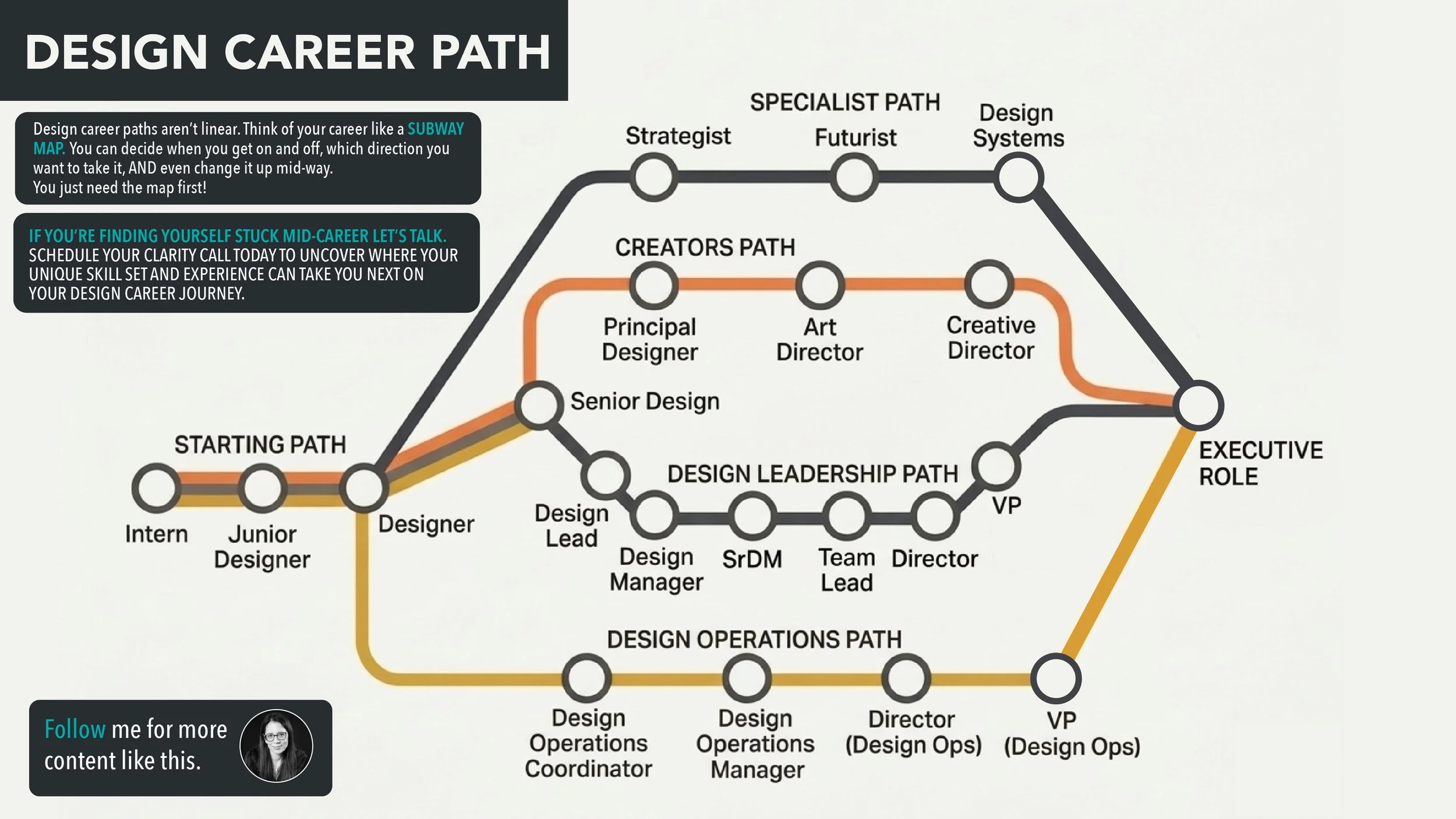
Career path for designers.
For decades, creative careers have been framed as linear.
Designers are taught to believe that progress follows a clear path: junior designer to mid-level designer, mid-level to senior designer, and then onward to leadership. Each step builds on the last. Each promotion signals growth, mastery, and forward momentum.
In the early stages, this model works.
Designers focus on building craft, learning tools, and developing taste. Career progression feels structured and predictable, especially in junior designer and mid-level designer roles where expectations are clearly defined.
But at the senior level, that structure starts to break down.
Why the senior designer career path is no longer linear
“Senior Designer” is often seen as a milestone. In reality, it is a pivot point in the design career path.
Part of the confusion comes from how much the industry has changed.
The traditional creative agency career path once offered a relatively clear progression: junior designer to senior designer to art director to creative director. This model created a shared understanding of what growth looked like in design careers.
Today, that model is only one of many.
The modern design landscape is far more fragmented. Designers are now navigating multiple career tracks, including:
Design leadership roles
People management paths
IC (individual contributor) to design manager transitions
Strategic and systems-focused design roles
Cross-functional product and business roles
Titles vary across companies. Expectations are inconsistent. Two senior designers may be doing entirely different work depending on the organization, scope, and maturity of the design function.
This is why many designers begin searching for things like:
how to become a design director
how to transition from IC to design manager
what is the senior designer career path
career strategy for creatives
Each path is valid. None of them are clearly mapped.
Why senior designers feel stuck in their careers
When designers plateau at the senior level, the default assumption is often that they need more skills.
In most cases, that is not true.
Senior designers already have a strong and diverse skill set. They can execute at a high level, lead projects, collaborate cross-functionally, and take ownership of complex design problems. Many are already performing at or above design lead expectations without the title.
The real issue is not capability.
It is lack of clarity around career direction.
Most designers have never been taught how to define a design career strategy or how to evaluate which path fits their strengths and goals. As a result, they default to doing more of what already works.
🎥 Watch my Masterclass on ‘3 Ways To Get Unstuck - In Your Creative Career’
The trap of doing more as a senior designer
In the absence of clarity, many designers fall into a familiar pattern: they take on more responsibility.
More projects.
More ownership.
More visibility.
On the surface, this looks like career progression.
And in some cases, it is rewarded.
But over time, it often creates a plateau in disguise.
Additional responsibility reinforces the current role rather than creating a new one. Designers become highly valuable in their current position but remain unclear on how to move into the next stage of their career, whether that is design management, creative leadership, or specialization.
Even common advice like improving a portfolio for senior designer roles is limited without direction. A portfolio without a defined career path becomes a collection of past work rather than a tool for positioning toward future roles.
How to become a design director or design manager: the real shift required
At the senior level, the question is no longer “How do I get better at design?”
The real question becomes: “Where am I trying to go in my design career?”
This is where most designers need a shift in thinking.
To become a design director, for example, the work is no longer just about craft. It involves:
developing a clear design point of view
influencing stakeholders and business direction
leading vision across teams and systems
Similarly, the transition from IC to design manager requires a shift from individual execution to:
team performance and development
coaching and feedback
organizational impact and delivery alignment
These are not incremental upgrades. They are fundamentally different career paths within design leadership.
Why career strategy for creatives is now essential
Historically, many designers relied on managers or creative directors to help guide their progression.
But in today’s environment, that support structure is weakening.
Many managers are focused on delivery, timelines, and business outcomes. In fast-moving teams with high turnover and constant pressure, there is often limited capacity for structured career coaching or long-term development planning.
As a result, designers are increasingly responsible for defining their own career strategy for creatives.
This includes:
identifying the right career path (IC, manager, leadership, or hybrid)
understanding what skills map to that direction
learning how to position their experience for future roles
Without this clarity, even highly skilled designers can remain stuck for years.
Redefining the senior designer career path
The ladder metaphor persists because it simplifies career growth in design. It suggests there is one path forward and that progress is always upward.
But for senior designers, that model no longer applies.
Careers at this stage are not linear. They are multidirectional.
Progress is no longer about climbing. It is about choosing a direction, understanding where it leads, and aligning your work accordingly.
Designers who navigate this effectively are not necessarily doing more work. They are doing more intentional work. Their decisions compound because they are aligned with a clear career direction.
In an industry that continues to evolve, that clarity becomes a competitive advantage.
Work with me
If you are a senior designer, design lead, or aspiring design manager and you are currently unclear on your next step, this is exactly the kind of work I support designers with.
In a career strategy discovery call, we will:
map your current position in your design career
identify realistic next-step options (IC, manager, or leadership paths)
clarify how to position your experience for your desired direction
outline a practical career strategy for your next stage of growth
👉 If you want to explore this, you can book a discovery call with me HERE
Feeling Stuck in Your Design Career? 3 Ways to Move Forward
Managing Your Design Career - 3 Ways to Get Ahead and not stay stuck in role.
There’s a point in every design career where things stop feeling clear.
You’re no longer a junior designer newbie. You’ve gathered enough experience to be dangerous. You’ve been leading more and more: part of the process, the team, and interfacing more with the business. You’re doing more, owning more, contributing at a higher level.
And yet you’re not moving forward the way you expected.
Design Leads get STUCK at level without even realizing it. It starts with a slow increase in responsibility. Because a design lead is talented and reliable, they naturally become the "go-to" for the high-stakes stuff.
Before long, they’re leading critical meetings bridging the gap between design and business. They're doing the work of the role above them — without the title or the pay. The business leaders know they’ll step up. They count on it!
The truth is, you can become too valuable in a current role to be promoted. It’s a quiet trap — what I call the mid-career trap — and it’s where a lot of talented designers get stuck. Not because they aren’t capable, but because the path forward isn’t obvious anymore.
If you’re a Senior Design Lead feeling drained, it’s often not burnout—it’s overload.
At this stage, you’ve been told that doing more proves you’re ready for the next level. So you step up—shaping strategy, influencing decisions, mentoring others. But the title doesn’t change. The recognition doesn’t come. And the work keeps piling on.
So you hit a wall—and call it burnout. But more often than not, it’s misalignment. You’re not tired of design. You’re tired of operating at a higher level without a clear role, path, or definition of success.
That’s the mid-career trap. And getting out of it requires a different approach.
I break it down in my FREE masterclass: 3 Ways to Get Unstuck in Your Design Career — How to get out of the Mid-Career Trap.
In short, there are 3 ways to getting unstuck:
1) Don’t do it alone. Find help.
2) Get clear on what YOU want.
3) Gain the right exposure and visibility.
I’ve created a coaching program to solve this exact problem. If you’re looking to get to the next level in your design career and wondering where to start, then schedule a free strategy call to see if coaching is the right next step for you.

Types of Design Leaders
From hands-on makers to organizational leaders, design roles evolve dramatically after the “Lead” level. But with hybrid expectations on the rise, the lines between craft, people, and strategy are fading. This breakdown helps clarify the roles—and the skills—required to grow your impact.
Decoding the roles, from craft-obsessed Individual Contributors to Design Leaders leading large teams.
In the early days of a design career, the path is linear: Junior, Mid-weight, Senior. But once you hit the “Lead” threshold, the road forks. One path keeps you in the files; the other takes you into the boardroom. One focuses on the pixels; the other on the people and the “ecosystem.”
But that clean split is starting to blur.
In today’s volatile environment, companies are asking more from fewer people. Hybrid roles are becoming the norm, not the exception. Designers are expected to think like leaders earlier in their careers—owning not just the work, but the outcomes, the communication, and the influence around it. Design leadership is quickly becoming less of an option and more of a requirement.
Understanding these distinctions isn’t just about titles—it’s about knowing where your strengths lie and what kind of impact you want to have on an organization.
Here is the breakdown of three primary pillars of design leadership.
1. The Craft-Focused Roles
These leads are the “Guardians of Quality.” They are crafting and very much in the applications and files, focusing deeply on the how and the what of the creative output.
Design Lead / Principal Designer: Usually a high-level Individual Contributor (IC). They own the creative direction and execution of a product or project. They lead by doing, setting the bar for what “great” looks like without the burden of direct reports.
Creative Director: Most common in agencies or brand-heavy orgs. They are the keepers of the “vision” and storytelling. A great CD is a mentor who pushes the team’s conceptual boundaries while acting as the final gatekeeper for creative quality. They often lead creative teams, but can still teach by “doing” when needed. They are often seen a creative bridge to the execution delivering on the strategy.
Design Manager: A strategic operational role. Unlike a people manager, this role focuses on unblocking the “multi-functional” machine. They handle timelines, scopes, and briefs to ensure the process remains healthy, even if they aren’t yet managing a team of creatives. They may eventually have a direct report or two, but seldom are they leading larger design teams.
2. The People & Strategy Roles
These roles represent a shift away from hands-on creation. Their job is to build the ecosystem where great design can actually happen. This involves stakeholder diplomacy, roadmapping, and team architecture.
Senior Design Lead / Senior Design Manager – These roles step away from hands-on creation to focus on building the environment where great design happens. They are about influence, structure, and scaling impact, typically at the project level.
Team Lead / Director of Design – The bridge between the studio and the C-suite. They ensure design has a “seat at the table” by translating creative output into business KPIs that executives understand. Their primary KPI is the growth, well-being, and performance of the design team, while connecting the dots to business needs and setting priorities and focus. They operate at an organizational level, not just on projects—though they may lead large-scale initiatives if the team isn’t yet equipped to do so.
Head of Design / VP of Design – The high-level executive. They are responsible for the organization’s overall impact, culture, and long-term integration into the company’s business model. They define team structure, determine headcount, and identify the capabilities needed to scale design effectively.
3. The Specialized Leads
As a design org matures, it needs specialists to manage the pillars that support the broader team. These roles are the “Force Multipliers.”
Design Ops Lead: They focus on the “pipes”—the tools, workflows, and onboarding systems that make the team efficient and scalable.
Design Systems Lead: They treat the component library and brand guidelines as a living product, providing the “building blocks” that allow everyone else to move faster.
Research Lead: The voice of the “Why.” They lead the researchers to ensure the company isn’t just building beautiful things, but building the right things based on human-centric data.
Design Strategist – Focused on the “big picture.” They connect design work to business goals, customer needs, and market opportunities, ensuring design decisions are aligned with long-term strategy.
Which Path Are You On?
Whether you are on the technical craft path of a Principal role or the organizational and people path of a VP of Design role, clarity on these definitions is the first step toward a focused career.
It’s also worth noting: these are baseline definitions. In reality, roles flex. Titles vary widely across companies, and with the current lack of industry calibration—combined with the rise of hybrid expectations—many responsibilities overlap or get compressed into a single role.
Understanding the spectrum still matters. Even if titles blur, the skills required don’t. And these skills can transfer to finding the right role fit at the right employer.
If any of this resonates—if you’re feeling stretched, unsure of your next move, or ready to step into leadership without losing your craft—let’s talk.
I offer a 30-minute complimentary “Get Unstuck” call to help you clarify your path and identify if career coaching is the next step in your design career.
Mar 24, 2026 © 2026 Gabi Gonzalez | The Design Cohort. All rights reserved.